
Dad Talks #21: Darby Saxbe
In conversation with the scientist and author of the brilliant new book 'Dad Brain'

Remember last week when I said that you shouldn’t unsubscribe even though I was pulling back on this here Substack? Well I’m glad you didn’t. Because I had totally forgotten the fact that I was waiting on an email from Darby Saxbe, Ph D, a clinical psychologist and professor of psychology at USC (ahem… the actual USC to all you Gamecocks who also like to call your school Carolina when such a place already exists. Trust me. I’m sitting directly across the street from it. Go Heels.) who is known for her research on the neurobiological underpinnings of the transition to parenthood.
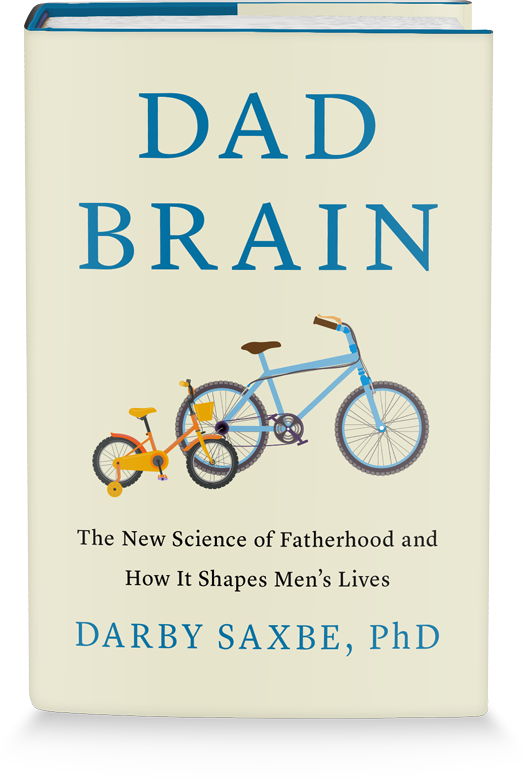
She’s also a newly minted author (of the book variety. Dr. Saxbe has published academic works, contributed to the New York Times, NPR, Slate, and Fast Company, and writes the excellent and deeply thorough Natal Gazing Substack) whose debut, Dad Brain: The New Science of Fatherhood and How It Shapes Men’s Lives is out June 9 from Flatiron Books.
I got my hands on an early copy of the book (an ARC or a “galley” for all of you publishing nyyyyerds) and have been devouring it over the last few days. It’s tremendous. But—and I’ve always wanted to say this—YOU DON’T HAVE TO TAKE MY WORD FOR IT.
Check out our conversation below.
Give me the elevator pitch on Dad Brain. BUT, to be clear, I want the pitch on the concept, not your book. Can you summarize what you learned in researching and writing the (presumably ~75,000-word) book in 500 words or less?!
This is a tough ask! I’d say I learned that we humans have a superpower, which is that we are flexible and adaptable. Our hormones and our brain structure can change when we enter into parenthood and encounter new demands. Fathers have a slightly different entry into parenthood than mothers do, but many of the key impacts of the transition to parenthood - from the way it shifts our priorities, our relationships, our identities, and our lifestyles - are shared across both genders, and are reflected in our neurobiology. The fatherhood role has shifted over the last 50 years and contemporary men are more hands-on with their kids than their fathers and grandfathers were. That adds a lot of richness and fulfillment to men’s life, but it also carries the risk of stress and burnout. Dads are navigating some new terrain these days.
“Over the last decade, researchers have discovered that having a child profoundly transforms our brains, hormones, and sense of self. Most studies have (understandably) focused on mothers. Until recently, the transition to fatherhood has been overlooked.”
I lifted this quote from your book’s Amazon page because I absolutely love it. I love the fact that you focus on dads while so much of science, research, and simple conversation around parenthood has always centered moms (presumably because moms have historically done more parenting). After all, centering the journey of fatherhood, and fostering honest and earnest conversations about being a dad is the reason I write this newsletter.
So my question is how long did it take you to ideate, research, and write this book?
Thanks for pulling out that quote! I do think it’s time to put some of the focus on dads for a change, because they are parents too. I got the book deal a little over two years ago, in May 2024. I turned in a rough first draft of the book in February 2025, got edits back in June, and spent another couple of months rewriting most of the second half of the manuscript. Then there were a few months of copy-edits and final touches. So all told the book took more than a year to write, but it also took me over a decade to lay the groundwork for it through the research I had been doing in my lab, starting when we recruited the first couples into our longitudinal transition-to-parenthood study in 2013.
Further to that question, why do you think it’s taken so long to finally start researching, writing, and learning more about fatherhood?
Great question. I think there’s a justifiable emphasis on mothers because they so frequently take the lead role in parenting, and because their bodies and identities visibly change across the transition to motherhood. In the last decade, we learned a lot about the neurobiology of pregnancy, breastfeeding, and mothering. There have also been valuable efforts to raise awareness about maternal mental health problems and shine a spotlight on moms’ stress, burnout, and frustration. But in not studying fathers, I think we miss the chance to make some interesting discoveries about parenthood. How does men’s socialization intersect with their experiences as parents? How is bonding with the new baby different for dads? The fact that men also show hormone and brain changes with parenthood is fascinating to me, because it tells me that your neurobiology can reflect experience-dependent plasticity even in the absence of the hormonal changes attached to pregnancy and birth. I think the research is starting to catch up and shine more of a spotlight on dads.
How has your parenting evolved in learning about the Dad Brain? Has it informed your mom brain?
I’ve probably become a worse parent in the course of writing this book, because it’s absorbed so much of my time and energy! And my husband has had to pick up the slack in multiple domains. So if anything the book-writing experience has made me appreciate alloparenting (MIKE NOTE: “alloparenting” is a term for any form of parental care provided by an individual towards young that are not its own direct offspring. In a word, the “Village.”) and the extent to which we truly do need a lot of helpers to raise our kids.
Potential Spoiler Alert: What was the most jaw-dropping thing you learned while researching and writing the book?
There’s a chapter on paternity uncertainty and how fathers can tell whether a particular child is actually theirs. This is tricky for humans because we conceal our ovulation, so men don’t always know whether a particular coupling will lead to a pregnancy. In digging into this research, I discovered that there are also high rates of uncertainty and confusion among marmosets, tiny South American monkeys. Marmosets are almost always born as twins or triplets, and they have very high rates of chimerism, in which fetuses exchange blood and stem cells in utero and end up being genetic mix-ups. A marmoset can actually have two different fathers, because a male marmoset’s sperm can carry the DNA of his twin brother. That means he can produce a baby who is actually his brother’s genetic offspring. Scientists think that this shared gene pool makes it easier for marmosets to recognize their relatives and helps motivate cooperate, hands-on care in marmoset fathers. Multiple babies could theoretically be related to them, so they work harder to care for all the offspring in the community.
Dad Talks typically end with the same question: "What kind of father was your father? And what about his fathering style have you adopted in your own work as a dad? What about his style have you consciously tried to avoid?" And I want to ask you the same question but (and hopefully without causing any marital strife!), I wonder this about your husband. How has watching your husband be a father informed you as a mother? What have you learned from him? What missteps have you watched him take along the way? And how have you helped him correct those things?
I am very lucky because my dad was a great dad - I write about him in the book and how he really stepped up as a father after my parents got divorced. He invested a lot of time and energy into me and my siblings, and he did it solo, because my mom moved out and remarried. I am doubly lucky because I married a great dad. In fact, part of why I was so attracted to my husband from the very start of our relationship is that he was good with young kids and seemed to be good dad material. Raising teenagers has its own challenges, but he is patient and emotionally present with our kids when they are struggling, and he is also fun and genuinely enjoys spending time with them. Honestly one of my favorite parts of being married to him is watching him as a parent. In terms of missteps, he can sometimes overreact when my son talks back to him. Fourteen-year-old boys can be genuinely infuriating, but I often have to remind him to take a breath and calm down before taking the bait.
Enjoyed this conversation!
Thanks for this conversation, MIchael. Enjoyed the new emphasis on dads in parenting.